
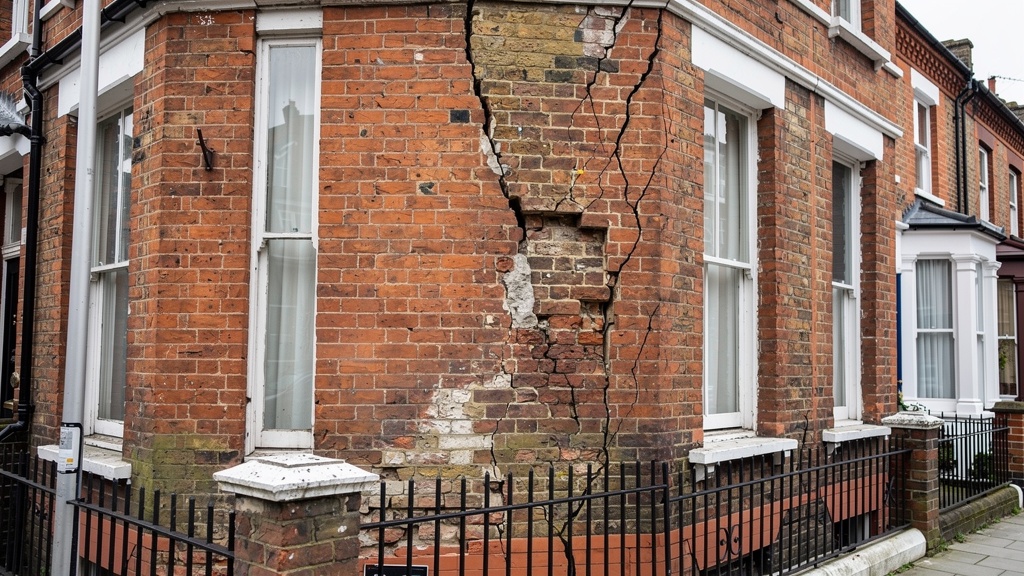
Cracks in walls are one of the most common — and most misunderstood — concerns raised by property buyers and homeowners. At Hampton Surveyors, barely a week goes by without a client calling in a panic about a crack they've noticed, convinced their home is about to fall down. The good news: the vast majority of cracks in residential buildings are entirely harmless. The bad news: some are not — and knowing the difference is critical.
This guide explains everything you need to know about structural cracks and subsidence in UK residential properties: how to identify them, what causes them, when to worry, and what to do next. This is the advice we give our clients every day — clear, practical, and free of unnecessary alarm.
The Different Types of Crack: A Practical Classification
Not all cracks are equal. The starting point for any assessment is understanding what type of crack you are looking at. Surveyors use the Building Research Establishment's (BRE) classification system, which grades cracks from Category 0 (hairline, negligible) to Category 5 (very severe, requiring major structural intervention).
Category 0 & 1: Hairline and Fine Cracks (0–1mm)
These are the cracks you see in plaster and render, often as a fine network of lines, or as single cracks following mortar joints. They are almost always caused by normal thermal movement — buildings expand and contract with temperature changes — or by the natural drying and shrinkage of plaster and mortar after construction or renovation. They require no structural action, only cosmetic redecoration. You will find these in virtually every property in Britain.
Category 2: Slight Cracks (1–5mm)
Cracks in this category are clearly visible but still relatively narrow. They may follow the line of mortar joints in brickwork, appear above door frames, or run diagonally from the corners of window openings. The majority are still non-structural — caused by seasonal movement, minor differential settlement in the early years of a building's life, or thermal expansion — but they warrant closer inspection. A surveyor will look at the crack's pattern, location, and whether it shows signs of ongoing movement.
Category 3: Moderate Cracks (5–15mm)
At this width, cracks become a more serious concern and typically require investigation by a structural engineer or RICS building surveyor. They may be causing noticeable distortion to door frames or window reveals, and there may be evidence of water penetration. This category does not necessarily indicate subsidence — but it needs professional assessment to rule it out.
Category 4 & 5: Severe to Very Severe Cracks (15mm+)
These are serious structural defects. Wide cracks — particularly those accompanied by visible distortion of walls, floors that slope noticeably, or doors and windows that have become impossible to open or close — require urgent professional investigation. At this level, there is likely to be significant structural movement, potentially involving foundations. Remedial works can be costly and complex.
What Causes Structural Cracks?
Understanding the cause is just as important as measuring the width. The same width of crack can be benign or alarming depending on what is driving it.
Subsidence
Subsidence is the downward movement of the ground beneath a building's foundations, causing the structure to sink — usually unevenly, which is what creates cracking. It is one of the most feared words in property, and for good reason: dealing with it can cost tens of thousands of pounds and cause significant disruption.
In the UK, subsidence is most commonly caused by:
- Clay shrinkage: London and much of South East England sits on London clay, which shrinks significantly during dry summers and expands in wet weather. During prolonged dry spells, the clay beneath foundations can shrink away from the building, causing it to sink. This is cyclical — properties may crack in summer and partially recover in winter — but repeated cycles cause cumulative damage.
- Tree root activity: Large trees near a building extract moisture from clay soil, causing it to shrink. The roots themselves can also physically displace or undermine shallow foundations. Species with particularly aggressive root systems — oaks, willows, poplars, horse chestnuts — are the most commonly implicated.
- Leaking drains: Water leaking from below-ground drainage can wash away the fine particles in the soil beneath foundations (a process called erosion or 'piping'), leaving voids that cause settlement.
- Mining activity: Less common in West London but relevant in other parts of the UK — historical mining can leave underground voids that collapse over time.
Subsidence cracks tend to be diagonal, wider at the top than the bottom, and often appear at structurally vulnerable points — corners of windows and doors, junctions of walls, and at changes in foundation level. Critically, they tend to show signs of ongoing movement: the edges of the crack are fresh and sharp, there is no old paint or filler in the crack, and the crack may appear to be growing over time.
Heave
The opposite of subsidence — heave is the upward movement of the ground, usually caused by clay expanding as it reabsorbs moisture. It is less common than subsidence but can be equally damaging. It frequently occurs after a large tree is removed: the tree had been drying out the clay, and once removed, the clay rehydrates and expands upward. Cracks caused by heave tend to be wider at the bottom than the top.
Settlement
Settlement is the gradual compression of soil under the weight of a new building. Almost all buildings experience some settlement in the first few years after construction, particularly on cohesive soils. It is usually benign — the building settles evenly — but uneven settlement (differential settlement) causes cracking. Settlement cracks are typically stable once the building has finished moving, which distinguishes them from active subsidence.
Thermal Movement
All building materials expand when heated and contract when cooled. Over a typical UK year, temperature variation of 40°C or more is not unusual. Without adequate movement joints, this expansion and contraction causes cracking — particularly in long runs of brickwork, concrete, or render. Thermal movement cracks tend to be vertical or horizontal, follow regular patterns, and occur at predictable locations.
Lintel and Support Failure
Lintels — the structural members spanning above doors and windows — can corrode (in older properties with early steel lintels), crack (in properties with concrete lintels), or fail through age. This often produces distinctive diagonal cracks running down from the corners of openings at roughly 45 degrees. Similarly, the failure of a structural wall, beam, or column can cause significant and very visible cracking in the structure above.
Key Signs That a Crack May Be Structural
When assessing a crack — whether as a homeowner, buyer, or someone about to commission a survey — look for these indicators that suggest a crack warrants professional investigation:
- The crack is wider than 5mm at any point
- The crack is diagonal, running from the corners of windows or doors at approximately 45 degrees
- The crack is wider at one end than the other (tapered)
- There is visible displacement — one side of the crack sits higher or lower, or protrudes further than the other
- The crack appears on both the internal and external face of the wall
- There are multiple cracks showing a similar pattern or direction
- Doors or windows in the area have recently become stiff or impossible to close
- There are signs of recent movement (sharp, clean crack edges, no filler or paint inside)
- The crack has reappeared after being repaired or filled
- There are large trees within 5–10 metres of the building
What Should You Do If You Find a Crack?
If you are a homeowner who has noticed a new or growing crack, or a buyer who has seen cracks during a property viewing, the most important thing to do is not panic — and then get proper advice.
Monitor it: For minor cracks that don't meet the criteria above, simply mark the ends of the crack with a pencil line and date, then check it every month. A crack that remains stable over a full year is very unlikely to represent active structural movement.
Commission a survey: For anything larger than 5mm, diagonal, tapered, or showing signs of active movement, commission a Level 3 Building Survey from a RICS building surveyor. This will give you a professional assessment of the crack's likely cause, severity, and the most appropriate remedial action.
Check your insurance: If subsidence is confirmed, you must notify your buildings insurer. Most standard buildings insurance policies cover subsidence damage, but there are important conditions — including the requirement to notify promptly and not to carry out remedial works without insurer approval.
Get a structural engineer's report if required: For confirmed or suspected severe subsidence, your surveyor may recommend a specialist structural engineer's report, potentially including trial pits to inspect the foundations, borehole tests to assess soil conditions, and a programme of monitoring.
Structural Cracks in Hampton and West London
Hampton and the surrounding West London area presents some specific challenges when it comes to cracking and structural movement. The area sits on London clay, which is particularly prone to seasonal shrinkage and swelling. The abundance of mature trees — including the many fine oaks, chestnuts and willows near the River Thames, Hampton Court Park, and along residential streets — means tree-related subsidence is a genuine and recurring issue.
Victorian and Edwardian terraces, which make up a significant proportion of the local housing stock, typically have shallow strip foundations that were not designed with the potential for clay movement in mind. Many properties in the area will show some degree of historic crack repair — this is not necessarily alarming, but it needs to be interpreted by someone who knows the local geology and building stock.
At Hampton Surveyors, our team has surveyed hundreds of properties in Hampton, Twickenham, Feltham, Richmond, Kingston and the wider area. We know the local ground conditions, the tree species most commonly causing problems, and the typical building defects in properties of different ages. That local knowledge makes a real difference when interpreting what a crack means for your specific property.
"The Level 3 Survey from Hampton Surveyors identified diagonal cracking at both corners of our rear extension that turned out to be caused by a large oak tree 4 metres from the back wall. Armed with the report, we got a 12% reduction on the asking price and the seller agreed to fund the initial tree management works. Absolutely invaluable."
— Robert & Claire M., Property Buyers, Hampton Wick
Frequently Asked Questions
Yes, you can sell a house with subsidence — but you must declare it to prospective buyers in the TA6 property information form. Most buyers will want a full structural survey and a specialist engineer's report. Properties with a history of subsidence that has been properly investigated, stabilised (often by underpinning) and signed off by an engineer can be mortgaged and insured, though the process is more complex. Transparency is always the best approach.
Most standard buildings insurance policies cover subsidence damage, but conditions apply. You must notify your insurer promptly when you suspect subsidence. Most policies have a standard excess for subsidence claims of around £1,000. Properties that have previously had subsidence may attract higher premiums or excesses. Always read your policy documents carefully and speak to your insurer before undertaking any remedial works.
Underpinning costs vary enormously depending on the extent of the problem, the foundation type, and access constraints. A single bay of mass concrete underpinning to a standard terrace might cost £3,000–£8,000; full underpinning of a detached house with complex foundations could run to £50,000 or more. Your structural engineer should provide a cost estimate alongside their recommendations. Note that underpinning is not always necessary — in many cases, tree management or drain repair combined with monitoring is sufficient.
No — diagonal cracks are not always subsidence. Many diagonal cracks are caused by lintel failure, differential settlement during the building's early life, or thermal movement at junctions between different materials. The key diagnostic factors are the crack's width, whether it's tapered, whether there's displacement across the crack, and whether it's currently active. A RICS building surveyor can assess these factors and give you a considered opinion.
Not necessarily. Cracks — even significant ones — don't automatically mean you should walk away. What matters is understanding the cause, the cost to remediate, and the ongoing risk. Many properties with a history of cracking make perfectly good purchases once the issue is properly understood and priced in. Our Level 3 Building Survey will give you the information to make a fully informed decision — and often a solid basis for price renegotiation.
Worried About Cracks in a Property?
Our RICS building surveyors assess structural cracks across Hampton, Twickenham, Feltham and Greater London. Get a clear, honest assessment.
Book a Building Survey About Level 3 Surveys