
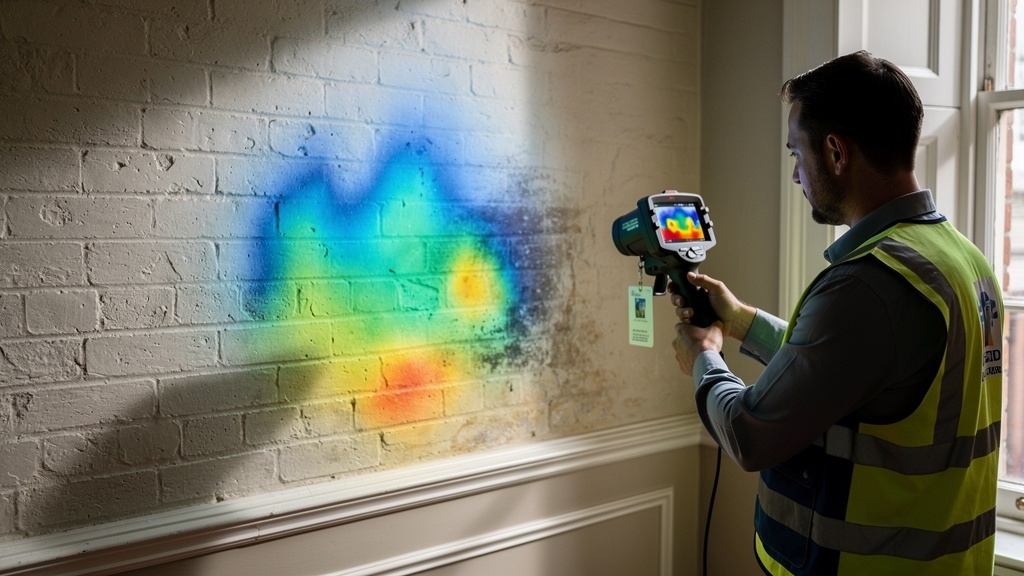
Hampton Surveyors uses thermal imaging technology as part of our advanced survey toolkit — and the results frequently surprise homeowners. A wall that looks perfectly fine can glow orange on an infrared screen, revealing trapped moisture, a missing patch of insulation, or a hidden water ingress route that would never show up in a standard visual inspection.
Thermal imaging surveys are not a gimmick. They are a proven diagnostic tool used by specialist surveyors, energy assessors and building engineers to see what the naked eye simply cannot. In this guide, we explain exactly how they work, what they detect, when you should commission one, and what to expect from the process.
What Is a Thermal Imaging Survey?
A thermal imaging survey — also called an infrared survey or thermographic survey — uses a specialist camera to detect surface temperature differences across walls, ceilings, floors and roofs. Every material emits infrared radiation, and the camera captures this as a colour-coded image: warmer areas appear in reds and oranges, cooler areas in blues and purples.
Crucially, it is not an X-ray. A thermal camera does not see through walls. What it detects are temperature anomalies on surfaces, which indicate something abnormal behind them. A patch of damp plaster will be cooler than dry surrounding plaster because moisture evaporates and cools the surface. A gap in cavity wall insulation will appear as a cold bridge — a thermal bridge where heat escapes from the building envelope. A leaking heating pipe inside a floor will appear warmer than the surrounding screed.
These variations — sometimes as small as 0.1°C — are invisible to the human eye. A calibrated infrared camera with a trained operator can pick them up instantly, turning a multi-day investigative job into a 30-minute diagnostic scan.
What Can a Thermal Imaging Survey Detect?
Used correctly, a thermal imaging survey can identify a surprisingly wide range of building defects and energy performance issues:
1. Hidden Damp and Water Ingress
Damp is the most common defect we find with thermal imaging. Moisture behind plaster, inside cavity walls, beneath floor screeds, or hidden within ceiling voids shows up clearly as a cool, irregular zone on the thermogram. This is particularly useful in older Victorian and Edwardian properties where damp problems are common but often invisible at the surface level.
We regularly discover water ingress routes that have been active for months or even years, quietly rotting out timber, degrading plaster and creating conditions ideal for black mould — yet completely invisible to the previous surveyor who relied on a damp meter and visual inspection alone.
2. Missing or Damaged Insulation
One of the most commercially significant findings is poor insulation. Modern cavity wall insulation can settle, shift, or was poorly installed in the first place, leaving voids where cold air can circulate. Thermographic scanning quickly identifies these gaps — information that is extremely useful when buying a property or assessing its energy efficiency prior to a Green Deal or retrofit grant application.
Loft insulation that has become compressed, wet, or displaced over time also shows up clearly, as does missing pipe lagging in roof voids — a common cause of burst pipes in cold weather.
3. Cold Bridges and Thermal Defects
Thermal bridging occurs where heat escapes through a structural element that bypasses insulation — for example, at floor-to-wall junctions, around window and door frames, or at the head and cill of openings. These cold bridges are not just energy-wasting — they can trigger condensation and surface mould growth because the surface temperature drops below the dew point.
4. Electrical Hot Spots
Overloaded circuits, faulty connections, or failing components in electrical systems can generate excessive heat — sometimes a precursor to an electrical fire. A thermographic scan of a consumer unit and visible wiring can identify dangerously hot connections before they become a serious safety issue.
5. Underfloor Heating Faults
Underfloor heating systems — particularly wet systems embedded in screed — are notoriously difficult to inspect visually. Thermal imaging clearly shows the pattern of heating pipes beneath the floor surface, immediately revealing broken loops, airlocks, blocked zones, or areas where the screed has been cut through (by a later tradesperson who didn't know the pipes were there).
6. Flat Roof Defects
Flat roofs are a common problem area for British homes. The thermal camera shows moisture trapped within the roof build-up, identifying the precise location of water ingress without the need for destructive investigation. This is invaluable before commissioning expensive flat roof repairs or replacements.
7. Structural Anomalies
In some cases, thermal imaging can reveal features of a building's structure that are not apparent from the exterior — for instance, the line of hidden structural beams or columns in a wall, the presence of a former window or doorway that has been bricked up, or areas of different construction that might indicate unauthorised alterations.
The Limitations of Thermal Imaging
It is important to be honest about what thermal imaging cannot do. It is a supplementary diagnostic tool, not a standalone survey. A good RICS building surveyor uses thermographic data alongside a full visual inspection, physical probing, moisture meter readings, and professional judgement.
Results are highly dependent on conditions. For reliable results, there must be a meaningful temperature difference between inside and outside the building — generally at least 10°C. This means thermal imaging is most effective in autumn, winter and early spring in the UK, and least reliable on warm summer days when the building envelope is at a similar temperature to the external air.
The camera operator must also be appropriately trained. The Chartered Institution of Building Services Engineers (CIBSE) and the British Institute of Non-Destructive Testing (BINDT) both offer certifications for thermographic surveyors. At Hampton Surveyors, our team members who carry out thermal surveys hold the appropriate Level 1 or Level 2 thermographic certifications.
When Should You Commission a Thermal Imaging Survey?
There are several scenarios where we routinely recommend thermal imaging as part of — or in addition to — a standard building survey:
- Pre-purchase for older properties: If you are buying a Victorian, Edwardian or inter-war property, thermal imaging is a wise investment. These homes are full of hidden moisture pathways, inadequate insulation and cold bridges that a standard visual survey may not fully expose.
- Following a report that flags potential damp: If your Level 2 or Level 3 survey report identifies possible damp but cannot confirm the extent or source, a follow-up thermal imaging scan can map the precise extent and likely origin of the moisture.
- Pre-renovation thermal assessment: Before investing in insulation upgrades, underfloor heating, or extensive internal works, a thermographic scan gives you the baseline data to plan and cost the works accurately.
- Energy performance investigations: If your energy bills seem disproportionately high, thermal imaging will quickly identify where your property is losing heat — and what the most cost-effective remedial measures are.
- New-build defect investigations: New-build properties sometimes have insulation that was poorly installed or entirely missed by the site team. A thermal survey carried out within the first few years can identify these defects while the developer is still liable.
- Flat roof inspections: For any property with a significant flat roof area — whether a full flat roof, extensions, or garage roofs — thermal imaging is the gold standard diagnostic before repair or replacement.
What Happens During a Thermal Imaging Survey?
When Hampton Surveyors carries out a thermal imaging inspection, the process follows a structured methodology to ensure reliable, defensible results:
Pre-survey preparation: We ask homeowners to close all windows and doors for at least one hour before the survey, and to turn off any portable heaters that might artificially warm wall surfaces. Where possible, the survey should be booked for a cooler day to maximise the internal-external temperature differential.
Internal survey: Starting from the top of the building and working down, we systematically scan all wall surfaces, ceilings, floors, windows and doors. The camera is held at a standardised distance and angle to ensure consistent readings. Each image is date-stamped, geo-referenced within the building, and cross-referenced with a conventional photograph.
External survey (where conditions allow): An external scan can reveal moisture in the outer leaf of masonry, missing cavity wall insulation, and heat leaking through roofs. External thermal surveys are best carried out at dawn, when solar gain has not yet had time to warm the building surfaces artificially.
Report preparation: All thermograms are analysed using specialist software and compiled into a clear, annotated report. Each image is accompanied by the corresponding conventional photograph and a written description of the anomaly, its likely cause, and recommended action.
How Much Does a Thermal Imaging Survey Cost?
The cost of a thermal imaging survey depends on the size of the property, the scope of the inspection, and whether it is carried out as a standalone survey or as an add-on to a standard Level 2 or Level 3 building survey.
As a standalone service at Hampton Surveyors, a thermal imaging inspection for a standard 3-4 bedroom house typically costs from £295 including a full written report. When combined with a Level 3 Building Survey, we often offer this at a discounted rate — contact us for a personalised quote.
Consider the return on investment: identifying a significant damp ingress, faulty insulation, or an electrical hot spot before you buy or before you renovate can save many times the cost of the survey. We have seen clients save £15,000–£30,000 on a purchase price using evidence from a thermal imaging report as part of their negotiation.
Thermal Imaging Surveys from Hampton Surveyors
Hampton Surveyors offers thermal imaging surveys across Hampton, Twickenham, Feltham, Kingston upon Thames, Richmond, Sunbury-on-Thames and the wider West London area. Our RICS building surveyors combine infrared thermography with decades of practical building knowledge to give you the most complete picture of a property's condition.
Whether you want a standalone thermal scan, a combined Level 3 Building Survey and thermal investigation, or a pre-renovation energy performance assessment, our team is ready to help. We use the latest FLIR infrared cameras and our reports meet the standards recommended by CIBSE and BINDT.
"The thermal imaging scan revealed significant damp behind the kitchen wall — something I'd suspected but my standard homebuyer survey hadn't picked up. The Hampton Surveyors team explained everything clearly and the report gave me exactly what I needed to renegotiate the price. Worth every penny."
— Helen F., Property Buyer, Twickenham
Frequently Asked Questions
Thermal imaging is excellent at detecting active damp, moisture accumulation and water ingress that has reached the plaster surface or cavity. It is less reliable for very shallow, early-stage damp that has not yet affected surface temperature. We always combine thermal imaging with moisture meter readings and physical inspection for a complete damp assessment.
Technically yes, but the results are far less reliable in summer when external and internal temperatures are similar. We strongly recommend scheduling thermal imaging surveys between October and March for the best diagnostic accuracy. We will always advise you honestly if conditions are unlikely to produce useful results on a given day.
Not always. If you book a Level 3 Building Survey with Hampton Surveyors between October and March, ask us about combining it with a thermal imaging element for a reduced combined fee. For summer purchases or where a simpler Level 2 survey is appropriate, a separate thermal scan appointment may be the best option.
No. Thermal imaging cannot identify asbestos. If you suspect asbestos in a property — particularly one built or substantially renovated before 2000 — you need a specialist asbestos survey carried out by a licensed asbestos inspector. We can recommend accredited asbestos consultants in the Hampton and West London area.
A thermal imaging inspection for a typical 3-4 bedroom house takes approximately 1.5–2.5 hours on site. A larger property or one with complex roof structures, multiple extensions, or suspected widespread damp may take longer. The written report is typically delivered within 3–5 working days of the inspection.
Book a Thermal Imaging Survey
Available across Hampton, Twickenham, Feltham, Richmond, Kingston and wider West London. Fast turnaround. Full written report included.
Get an Instant Quote View All Services